How run-off insurance works
The easiest way to understand run-off is to first understand the difference between claims-made and occurrence-based liability insurance.
With a claims-made policy, the timing of the claim or valid notification matters. Broadly, cover responds through the current policy period, regardless of when the original act happened, provided the matter falls within the retroactive date and the policy conditions are met. That is why the current insurer usually responds, not necessarily the insurer on risk when the original work was done.
With an occurrence-based policy, the timing of the incident matters. If the insured event happened while that policy was on risk, that policy is generally the one that responds, even if the claim is made years later. That is why run-off is generally not needed in the same way for public and products liability.
Why old work can still create new claims
Professional negligence and management liability claims often surface long after the service was delivered or the decision was made. A client may only discover an error later, loss may not crystallise for years, or a buyer, liquidator, regulator or successor adviser may review historic conduct long after a business has been sold or closed.
That timing problem is exactly why claims-made insurance needs either:
- uninterrupted ongoing cover; or
- a run-off solution once the business stops, changes control, or the policy would otherwise end.
Which policies usually require run-off consideration?
Run-off issues most commonly arise under policy types that are generally written on a claims-made basis, including:
- Professional Indemnity
- Directors & Officers Liability
- Management Liability
- Employment Practices Liability.
Depending on the wording, some IT liability and other specialist professional liability products can also operate on a claims-made basis, so they should be reviewed the same way.
When do you usually need run-off cover?
Run-off should usually be considered when a claims-made policyholder is:
- retiring;
- closing a business or professional practice;
- selling a business;
- merging or going through a change in control;
- facing insolvency, liquidation or other structural change; or
- unable to maintain annual renewal of the existing policy.
It can also be required by:
- contracts with customers, principals, landlords or counterparties;
- professional rules or association requirements; or
- transaction documents in a business sale or corporate deal.
In D&O, change in control is a common trigger. KBI’s current D&O material notes that D&O policies often only respond to wrongful acts occurring before the effective change-in-control date, which is why run-off becomes a key issue in transactions.
Important: notify circumstances before the policy expires
This is the point many readers miss.
If you become aware of facts that may give rise to a claim, that should be raised with your broker and insurer immediately while the policy is still current. Under section 40(3) of the Insurance Contracts Act, written notice of those facts during the live policy period can preserve cover even if the actual claim is made later. Recent Australian case commentary has again reinforced that prompt notification is critical under claims-made policies.
That means run-off is not a substitute for good claims-made discipline. If you already know about a potential issue, the first step is usually to consider whether it should be notified now.

What run-off cover does and does not do
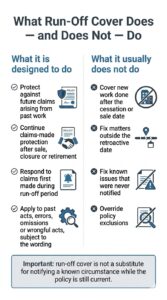
Run-off cover is designed to protect you for future claims arising from past work. It is not a blank cheque for every historic issue.
In broad terms, run-off cover is intended to:
- respond to claims first made during the run-off period;
- relate only to acts, errors, omissions or wrongful acts that happened before the cessation, sale or change date; and
- continue protection after you stop trading, subject to the policy terms.
It will not usually fix:
- work done after the cessation or change date;
- acts outside the retroactive date;
- known but unnotified circumstances; or
- matters otherwise excluded by the policy wording.
Check whether your current policy already includes automatic run-off
A common misconception is that run-off must always be bought separately from scratch.
Current Australian insurer guidance notes that many PI policies include an automatic run-off extension if the insured business ceases trading or is sold, but this often only lasts for the balance of the current policy period. If further protection is needed after that point, annual or multi-year run-off may need to be arranged separately.
That is why it is important to review the wording before you cancel, sell or allow the policy to lapse.
How long should run-off cover last?
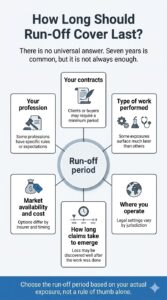
There is no single answer that suits every business.
A seven-year period is a common market benchmark and in some professions it aligns with minimum requirements. For example, NSW law practices must have indemnity for run-off liabilities for a minimum of seven years.
However, seven years is not a universal rule. Current market commentary warns that the right period depends on the nature of the services, contractual promises, statutory frameworks, when loss is suffered or discovered, and whether special claimant rules apply. In some cases, seven years may not be enough.
For some professions, there are separate frameworks altogether. Eligible doctors, for example, may fall within the Australian Government’s Run-Off Cover Scheme, although waiting periods and eligibility conditions can still make interim cover relevant.
As a practical rule, the run-off period should be chosen by reference to:
- your contracts;
- your profession or licensing framework;
- the jurisdictions in which you work;
- how long claims in your sector usually take to emerge; and
- the cost and availability of cover in the market at the time.
What affects cost and availability?
Run-off pricing is not one-size-fits-all.
Current Australian insurer guidance shows that run-off can be arranged either as:
- annual run-off cover, renewed each year; or
- multi-year run-off cover, where the period, premium and terms may be locked in upfront.
In practice, cost and availability are usually influenced by:
- the profession and type of services provided;
- claims history and any known circumstances;
- policy limit and excess;
- whether annual or multi-year cover is required;
- contractual or regulatory minimum periods; and
- insurer appetite and market capacity at the time.
Availability also matters. Current guidance notes that some insurers may not offer multi-year options in all cases, and some may only consider run-off for their existing insureds.
Practical examples
An accountant retires and closes the practice. Two years later, a former client alleges a historical error in tax advice. If the accountant had let the claims-made PI policy lapse without ongoing protection, that later claim may fall outside cover. This is the classic run-off scenario.
An engineering firm is sold. The buyer arranges its own insurance going forward, but a defect later emerges in work done before the sale. The seller’s past services exposure may still need separate protection.
A director leaves after an acquisition. If a claim later alleges wrongful acts before the transaction, D&O run-off may be critical to preserving protection for that legacy exposure.
Before you cancel, sell or close: a practical checklist
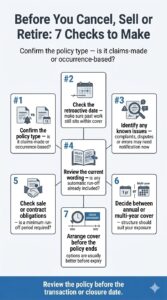
Before ending any claims-made liability policy, it is sensible to work through the following:
- Confirm whether the policy is claims-made.
- Check the retroactive date and whether cover has been maintained continuously.
- Identify any complaints, issues, facts or circumstances that may need notification now.
- Review whether the policy already provides automatic run-off, and when that extension ends.
- Check sale documents, service contracts, financing documents and professional rules for any required run-off period.
- Consider whether annual or multi-year run-off is the better fit.
- Arrange any required cover before sale completion, closure or policy expiry, rather than trying to fix it later.